Every couple fights. Almost nobody is taught how to fight well.
The complete relationship transformation system that teaches you and your partner how to turn conflict into connection, repair fast, and build a joyful, supportive love that lasts. Six pillars. Twenty-six guided steps. Built by a Licensed Professional Counselor.
You know the fight.
It starts over something small. A tone or a look feels off. Something about the dishes, or the calendar, or a text that went unanswered for four hours. Ten minutes later you are somewhere you have both been a hundred times before, saying things you’ve said before, feeling upset and getting nowhere.
Nobody feels heard. Nothing gets solved. And afterward, neither of you can explain how something that small got that big.
Then a week goes by, and it happens again.
Here is what makes it worse: you are both trying.
You have talked about it. Maybe more than once. You have each apologized, promised to do better, and meant it at the time.
The exhausting part is not the fighting. It is the sense that you are working hard at something but nothing is changing, and neither of you knows why.
So the fight goes underground. You stop bringing up the thing that bothers you because you already know how the conversation ends. You start editing yourself. There is a topic you both steer around now. Then two. The silence between you gets more comfortable than the talking, and that feels like peace for a while, until you realize how much is going unsaid.
That is the part that costs the relationship. Not the argument. The slow accumulation of things you both decided were not worth the fight that turn into distance and resentment.

Put The Conflict Code to use tonight.
After the short introduction and overview, dive into Pillar 1: Step 1, which culminates in the creation of your Reset Ritual Agreement. Together you’ll choose the signal you can use to call a pause, how long the break lasts, what each of you will do to calm down, and how you’ll find your way back. It takes about an hour. By the end of the night you have a written plan for the exact moment your fights usually go off the rails.


What This Step Is About
When a conflict starts to heat up, with tension, urgency, or emotional flooding, the most important move is to pause the interaction before it spirals. Without a clear plan for how to pause, many couples struggle with conflict right from the start.
This step introduces a third option: the reset ritual. A reset ritual is a co-created agreement that allows you to pause without disconnecting and to step back without stepping away. Instead of storming off or forcing resolution, you press pause.
A reset ritual communicates:
We’re not giving up on this conversation. We’re giving our nervous systems the space they need to come back with presence and care.
Three common pieces of advice that get it wrong.
Communication is not one skill. It’s many, and it’s an art form learned and developed over time. Most couples are strong in one area but lacking in others. Telling a couple to “communicate better” without a clear roadmap of how to learn and apply those skills in a real conflict will not help.
Sometimes the most useful thing two emotionally dysregulated people can do is sleep. When your heart rate is over 100, the part of your brain that listens has gone offline. Pushing through in that state is how a disagreement escalates into something you have to apologize for later.
Gottman’s long-term research found that roughly 69% of relationship problems are perpetual. They come from lasting differences in personality and preference, like how clean is clean enough or how money gets spent. Splitting the difference might buy you a quiet week, but the fight returns. To break the cycle, you have to get to what’s driving it, which is often hidden underneath.
All three are pop psychology, which the research contradicts. And not one of them tells you how.
At the University of Washington, John Gottman spent years watching couples argue on camera. From fifteen minutes of conflict, his team identified patterns that strongly predicted which couples would later divorce.
The predictor was never the topic. It was never how much they fought, or how loudly, or how angry they got.
What predicted the outcome was what happened after things went wrong. Whether one of them reached out. Whether the other one let them.
Among newlyweds who scored high on the most destructive conflict patterns Gottman identified, 84% of the couples who repaired effectively were still in stable, happy marriages six years later.
Same bad fights. Completely different outcome. The variable was repair.
Which means what stands between you and the relationship you want is a set of skills nobody ever taught you, and skills can be learned. There is a path, and you can walk it together.
A complete relationship transformation system.
Most relationship advice hands you a pile of techniques and leaves you to guess which one your situation needs. The Conflict Code is six pillars, each built on the last, that take you through the whole process, from the first pause to the relationship you’re building on purpose.
- 1Create your reset agreement
- 2Recognize dysregulation early
- 3Engage the body, not just the brain
- 4Try co-regulation tools together
- 5Re-enter the conversation with a regulated nervous system
- 1Set the tone and describe what happened
- 2Speak from the inside out
- 3Clarify and express what matters most
- 4Make the invitation clear
- 1Make space for listening
- 2Give them the floor
- 3Attune and show it
- 4Reflect what you hear
- 1Identify the pattern instead of the problem
- 2Name the unmet needs beneath it
- 3Name the wounds and false self-beliefs underneath
- 4Build a pattern-interruption pact
- 1Redefine repair and start with micro-repairs
- 2Acknowledge their experience without collapse
- 3Learn the art of embodied apology
- 4Show that it is safe to reconnect
- 5Create a rhythm of repair
- 1Build daily rituals of connection
- 2Define and defend your boundaries
- 3Create a weekly check-in
- 4Align on your shared vision
Handled well, a fight strengthens the bond between you and shows you what your partner actually needs.
What The Conflict Code actually is
An in-depth, self-paced course you and your partner work through together: six pillars, 26 guided steps, and 38 downloadable worksheets and reference cards.
Nothing is parceled out week by week. Each step opens as soon as you finish the one before it, so you set the pace, with no subscription and no clock.
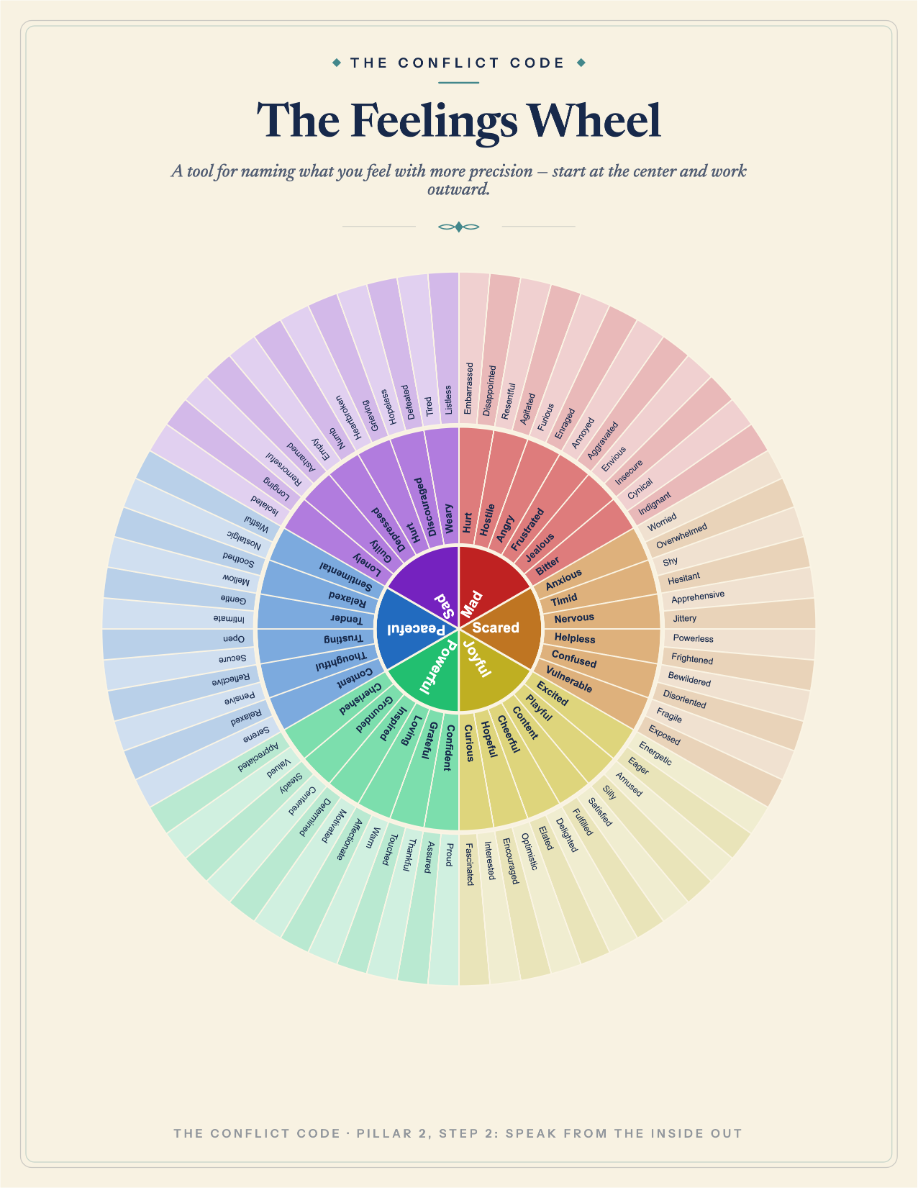
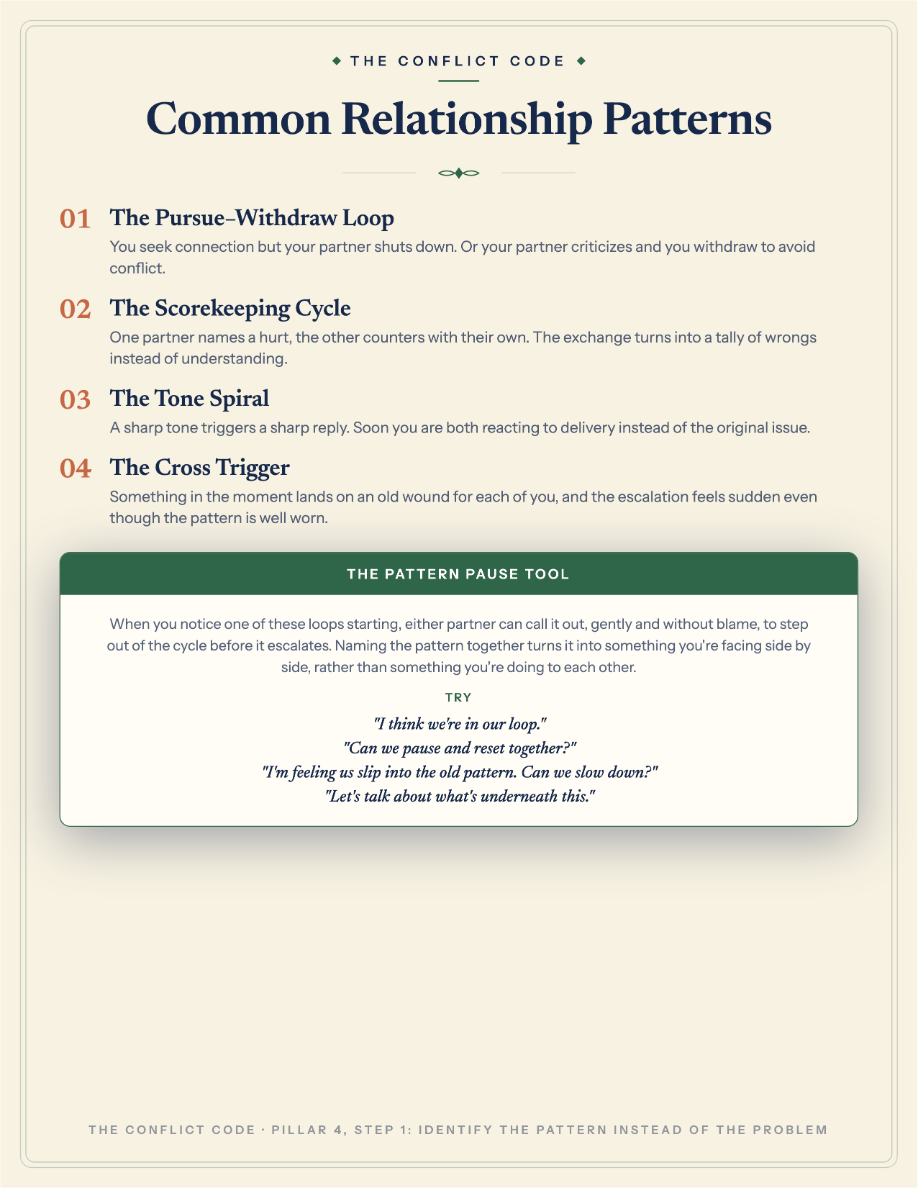
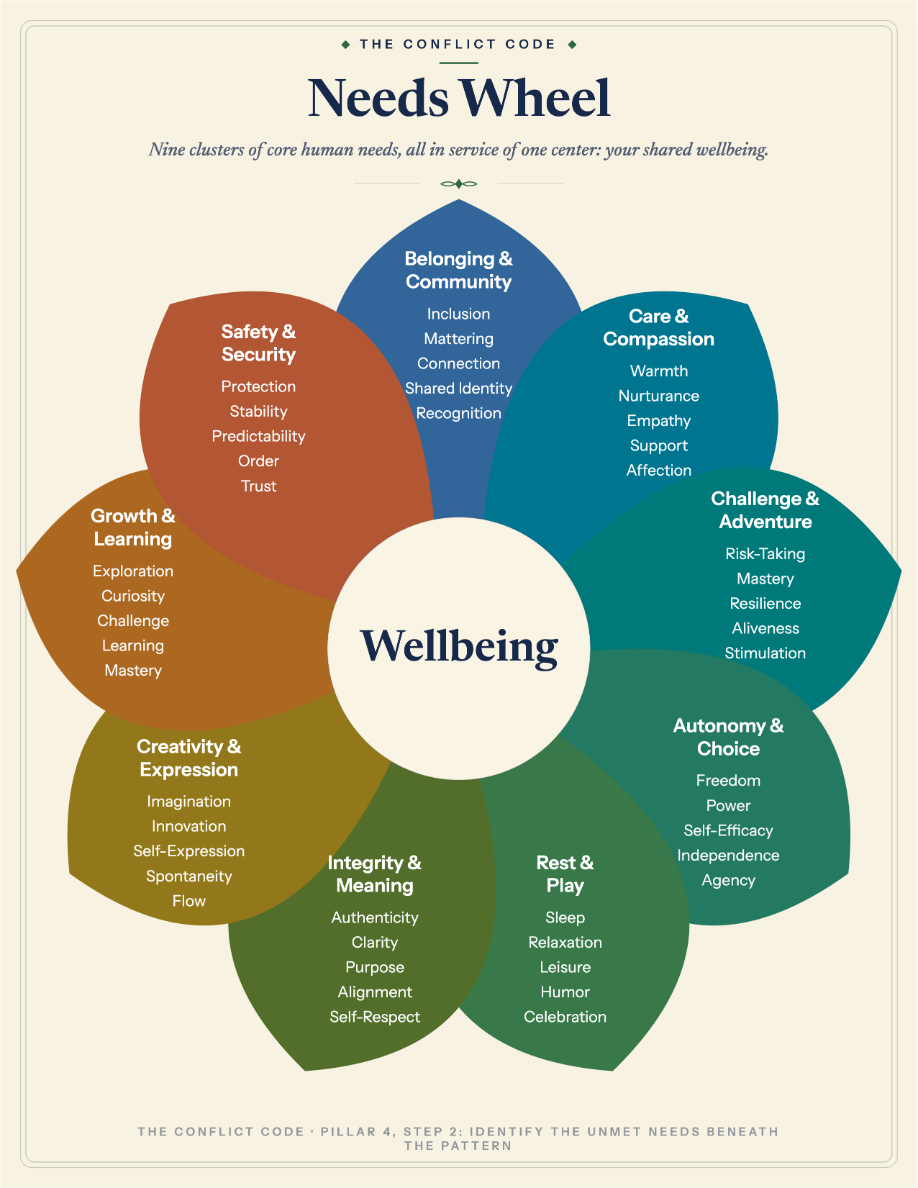
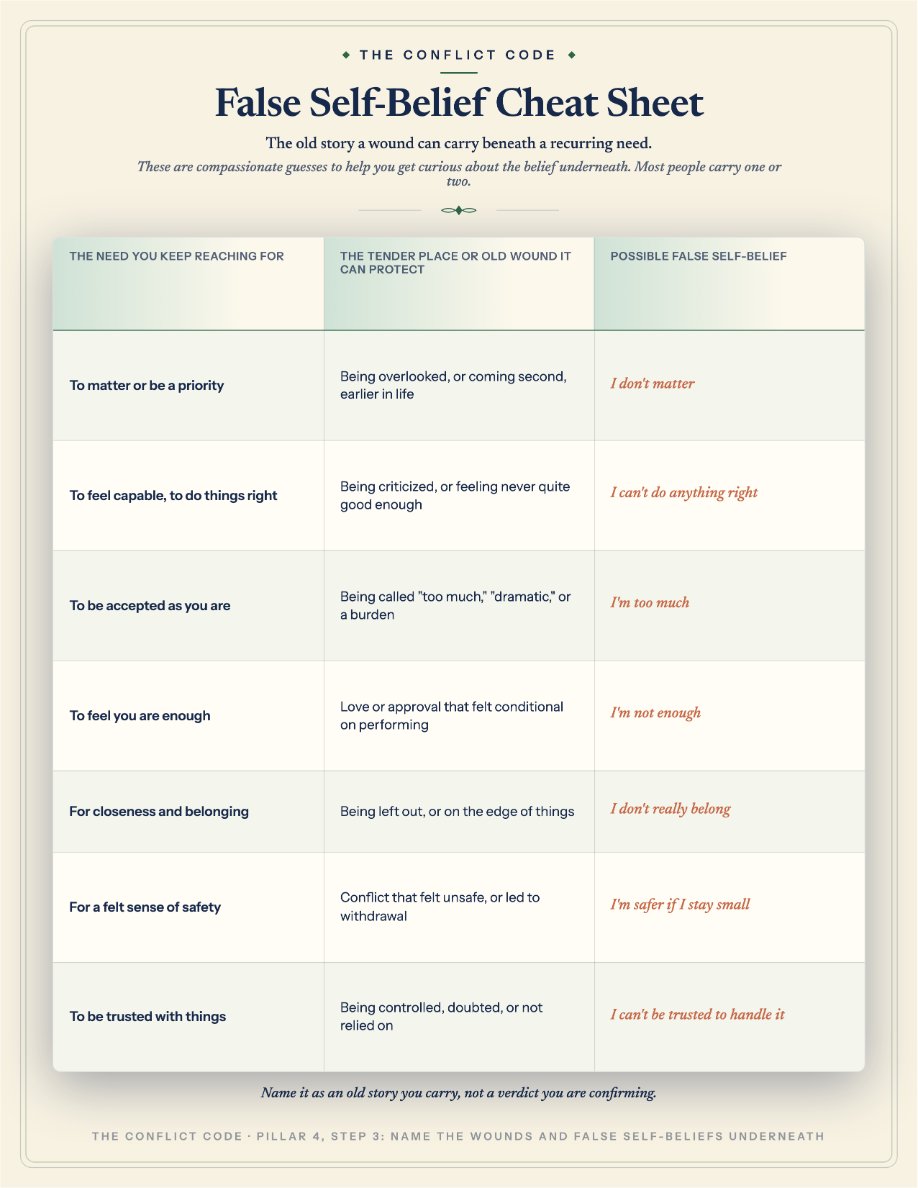
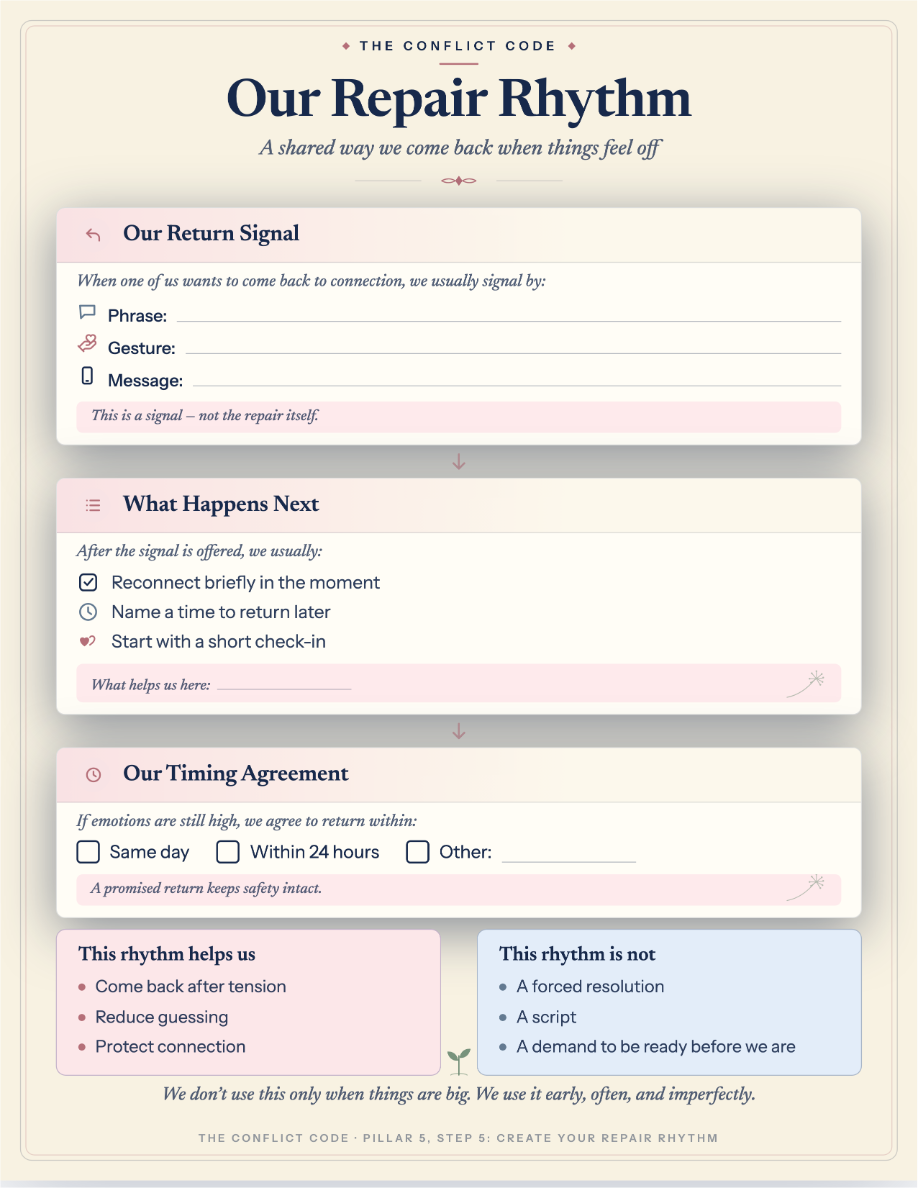
The worksheets are the same tools I use in session, from the Feelings Wheel to Our Repair Rhythm, made to print, fill in together and keep.

So you always know where you are.

Why trust me with this?
I’m Dan Entmacher, a Licensed Professional Counselor. I work with couples every week, and The Conflict Code is the framework I use with them, in the order I use it.
In my experience, difficulty handling conflict is the most common reason relationships break down, whether a couple avoids conflict or lives inside it. Both roads lead to disconnection. I built this course for the couples who need this work but can’t easily get to it. Therapy is expensive, waitlists are long, and plenty of couples aren’t in crisis. They’re stuck and tired, and they want something better than another article.
couples followed by Gottman’s team across four decades of research
how often couples who stayed together turned toward each other’s small bids for attention, compared with couples who divorced. Pillar 6 is built on that finding.
research citations, drawing on Gottman, Porges, Tatkin, Bowlby and Johnson, Rosenberg, and Siegel
The course is new, so there are no reviews yet. What there is: the research above, and a full refund if it doesn’t earn its price.

The same fight, a few months from now.
What it can look like once the six pillars are in place.
It starts over something small again. Your partner booked the weekend without asking, and you feel the heat climb up your neck before you’ve said a word.
This time you both catch it early. One of you says the word you picked that first evening, and the charge goes out of the room before anything gets said that you’d have to take back. You take your twenty minutes: a walk around the block for you, the back step and some slow breathing for them. When you come back, you’re both steady, and one of you asks, “Can we try again?”
You tell them what happened and what it meant to you. Because it comes as an invitation, they can actually take it in.
Your partner listens without jumping in to defend, then says it back, and they get it. Something in your chest loosens. You feel seen.
Then the real thing comes out: you’ve been feeling like an afterthought, and the weekend was just where it showed. Once it’s said out loud, the argument you’ve been having for years finally makes sense to both of you.
It ends with a hand on your arm, “I’m sorry I snapped,” and a real agreement: from now on, weekends get decided together. You finish the evening closer than you started it, and the next morning there’s a lightness between you that wasn’t there before.
That Sunday, at your weekly check-in, you each name something you appreciated about the week. Your partner picks the moment you came back and asked to try again. You pick the moment they got it. Then the conversation drifts toward the life you’re building, the trip you keep talking about, the kind of weekends you both want, and it starts to sound like a plan you’re making together.
You’ll still have hard conversations. Now they’re part of how you grow closer.
The one option that reliably works is priced out of reach for many.
Couples therapy runs $150 to $300 a session, and most insurance will not cover it without a diagnosis. A full course of treatment commonly totals $1,800 to $6,000. A weekend workshop runs $800 to $1,500 per couple, and a week-long private intensive $5,000 to $10,000.
What is it worth to stop having the same fight?
You have been paying for this fight for years, but instead of money, it costs your evening, then the day after, when you both feel far away. Twice a month, that adds up to weeks of every year spent inside the same argument.
Now picture those weeks coming back.
- Evenings enjoying each other instead of recovering.
- Knowing that when something goes wrong, you both know the way back.
- Feeling truly understood by the person you chose.
A fight you repeat is a pattern you are reinforcing. The same is true of repair.
Every time you handle it differently, the new way gets easier to reach for, until it becomes simply how you are together.
What this asks of you is one evening to put your first tool in place, then a few hours a week for a few months, together. The cost is less than a third of one therapy session.
Start with one evening.
The whole course is yours, for both of you, for life.
Everything you get
- The complete courseSix pillars, 26 guided steps and 38 printable worksheets, self‑paced
- Your first eveningA written reset plan you can use in your next argument
- Both partners, one purchaseWork through it together on any device
- Lifetime accessIncluding every future update to the course
- 3 free questions to the AI Course CoachAfter that, the Coach is a separate membership
no subscription
The “Worth It” guarantee. If within 30 days you don’t believe it was worth well more than you paid, email us and we’ll refund you in full. No forms, no exit interview.
Questions couples ask before they start
No. The Conflict Code is education, not treatment, and it doesn’t stand in for working with a licensed professional. It draws on the same research that couples therapists use and is designed to be useful on its own. It’s a good place to start before a pattern gets entrenched, and if you’re already in therapy, it works well alongside it.
Start anyway. A good portion of this work is about recognizing your own patterns, and that shift alone changes the dynamic between you. Plenty of people begin alone and their partner joins once they notice something is different.
These patterns are learned, which means they can be unlearned, including the ones with a decade behind them. Gottman’s research found that couples with genuinely destructive conflict habits still ended up in stable, happy marriages when they learned to repair. Long-standing is not the same as permanent.
Your first evening gives you a working reset plan. After that there’s no clock: the full course is designed for a few hours a week over a few months, at whatever pace fits your life. At the fastest pace we recommend, about eight weeks: one pillar a week for six weeks, plus two weeks of buffer for the weeks when life gets in the way. Each step takes about an hour, with 15 to 30 minutes of practice a few days a week. Any faster and new habits don’t have time to land. Taking longer is completely fine, and you own it for life, so nothing expires.
No. One purchase covers both of you.
A book explains. This includes a step-by-step process that builds as you go and has you doing something together. Every step ends with a practice and most come with a worksheet you fill in together, so you finish with actual agreements written down rather than a vague sense that you should communicate better.
Then you should not pay for it. Thirty days, full refund, no questions.
Stay in the loop, or break through?
You already know the pattern. You can feel it coming before it arrives. This time, you can end somewhere new: with both of you feeling heard and understood, the bond repaired, and a little more trust between you than when it started.
From The Complete Human LLC